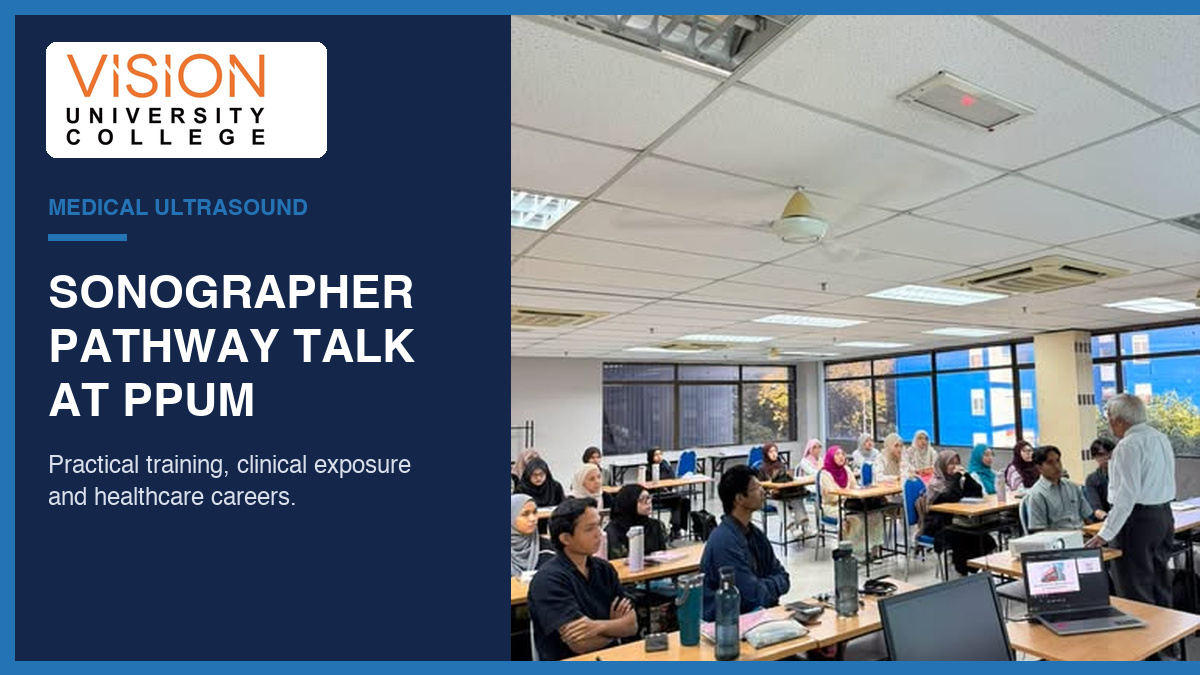
Participants attending the Sonographer Trainee (Medical Ultrasound) pathway sharing session.
Medical ultrasound plays an important role in modern healthcare by helping clinical teams examine internal organs, monitor pregnancies and support the diagnosis of a wide range of medical conditions. Behind every useful ultrasound image is a trained professional who combines technical ability, anatomical knowledge and patient-care skills.
Vision University College was pleased to share information about the Sonographer Trainee (Medical Ultrasound) pathway during a talk by Dato’ Dr. Nik Najib Bin Nik Abdul Rahman at Pusat Perubatan Universiti Malaya (PPUM). The session introduced participants to medical ultrasonography and highlighted the importance of structured education, practical training and clinical exposure.
What does a sonographer do?
A sonographer uses specialised ultrasound equipment to produce images that assist healthcare professionals in assessing a patient. The role requires more than operating a machine. Sonographers must understand anatomy and physiology, position patients correctly, capture appropriate images, maintain professional standards and communicate with patients in a calm and respectful manner.
Because ultrasound examinations are performed in real time, practitioners also need close attention to detail and the ability to adapt during an examination. These responsibilities make supervised, hands-on learning an essential part of preparation for the field.
Why practical and clinical training matter
Classroom learning builds the scientific foundation for medical ultrasonography, but clinical exposure helps trainees apply that knowledge in realistic healthcare settings. Through guided practice, trainees can become familiar with equipment, imaging techniques, patient interaction and professional workflows.
Structured training also gives learners opportunities to receive feedback, improve their technique and understand the responsibilities involved in delivering reliable imaging support. It can help aspiring sonographers develop both technical competence and the professionalism expected in healthcare environments.
Preparing for a meaningful healthcare career
Medical imaging is a field where technology and patient care meet. People considering this pathway should have an interest in health science, a willingness to learn continuously and the patience to develop precise practical skills. Good communication, empathy and professional conduct are equally important because sonographers work closely with patients who may feel anxious or uncomfortable.
The PPUM sharing session gave participants a clearer understanding of the opportunities in medical ultrasonography and the preparation needed to pursue them. It also demonstrated why collaboration between education and healthcare environments is valuable: learners gain a more realistic view of the profession and the expectations of the industry.
Vision University College remains committed to promoting healthcare education pathways that connect knowledge, hands-on learning and real industry needs. Those interested in the Sonographer Trainee pathway are encouraged to speak with the College about entry requirements, training arrangements and possible career development.