
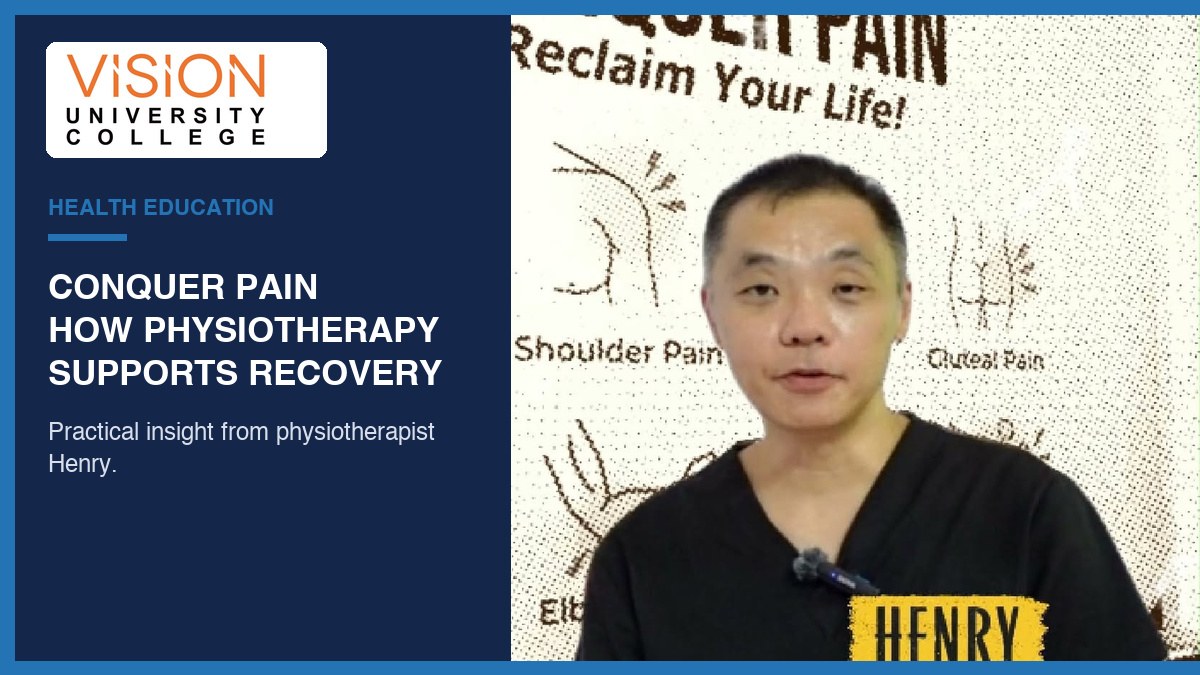
Physiotherapist Henry shares practical insight on pain, movement and recovery in a Vision University College educational reel.
Pain can affect far more than one part of the body. It may interfere with movement, work, sleep, exercise and participation in everyday life. When discomfort persists, people may become worried about activity and begin avoiding movements they associate with pain.
In Vision University College’s recent educational reel, physiotherapist Henry introduced the theme “Conquer Pain, Reclaim Your Life.” The sharing draws attention to an important idea: managing pain is not only about reducing symptoms. It is also about helping people understand their condition, move with greater confidence and return to meaningful activities safely.
What physiotherapy can contribute
Physiotherapy is used for a wide range of concerns, including muscle and joint problems, back and neck pain, sports injuries, rehabilitation after surgery and movement difficulties connected to some long-term conditions. A physiotherapist may assess symptoms, medical history, strength, balance, mobility and the way a condition affects daily activities.
Treatment is personalised. Depending on the individual and the underlying condition, it may include guided exercise, movement retraining, manual techniques, education and practical advice for managing symptoms. Home exercises may also form part of the plan, with progress reviewed over time.
The goal is not to offer one exercise or technique for every person. It is to build a programme that reflects the person’s needs, abilities, safety considerations and recovery goals.
Understanding pain and rebuilding confidence
Pain is real, but its relationship with movement can be complex. Some people become less active because they fear causing further harm. Extended inactivity, however, can also affect strength, mobility and confidence.
Rehabilitation can help people make sense of their symptoms and identify an appropriate route back to activity. Progress may involve pacing, starting from a manageable level, breaking activities into smaller steps and building gradually rather than doing too much at once.
This process should be individualised. Sudden, severe or persistent pain, pain following a major injury, or symptoms accompanied by weakness, numbness, fever or other concerning changes should be assessed by a qualified healthcare professional.
Recovery is about function and quality of life
The World Health Organization describes rehabilitation as interventions that optimise functioning and reduce disability. This means recovery is not measured only by a pain score. It may also include walking more comfortably, returning to work, participating in family activities, sleeping better or resuming a valued hobby.
Physiotherapy can be one part of that wider journey. Clear education, suitable activity and professional support can help a person set realistic goals and take an active role in recovery.
Through short educational content such as Henry’s sharing, Vision University College continues to connect healthcare knowledge with practical issues that matter to students and the wider community. The message is simple but valuable: pain should be understood carefully, and recovery should be guided by appropriate assessment rather than fear or guesswork.
This article provides general education and is not a diagnosis or personal treatment plan. Anyone experiencing pain should seek advice from a qualified healthcare professional for recommendations suited to their condition.
Health-information references: NHS physiotherapy overview; WHO rehabilitation overview; WHO low-back-pain fact sheet.